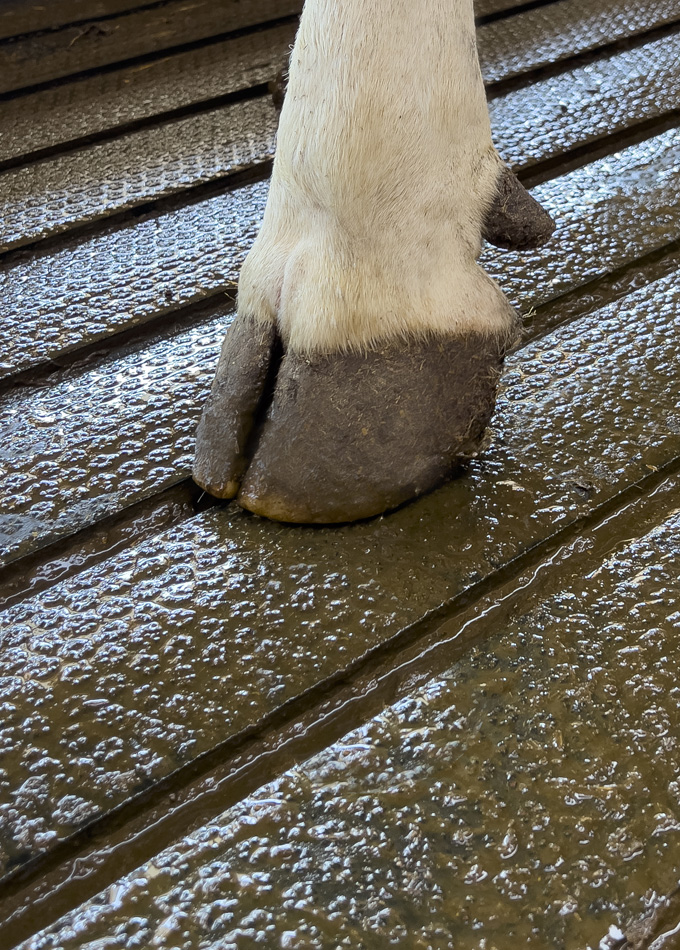
A recent study by Schrade, Bossler & Zähner (2025) examines the soiling of walking areas and residual soiling after manure removal. On 22 dairy farms, soiling of walking surfaces was recorded on various grooved floors and floors with slope.

The following results were published in the study:

• The proportion of clean surface area was 18 % on floors with slope and 10 % on grooved floors
• The proportion of urine soiled surface area was 0.2 % on systems with slope and 2.0 % on grooved floors
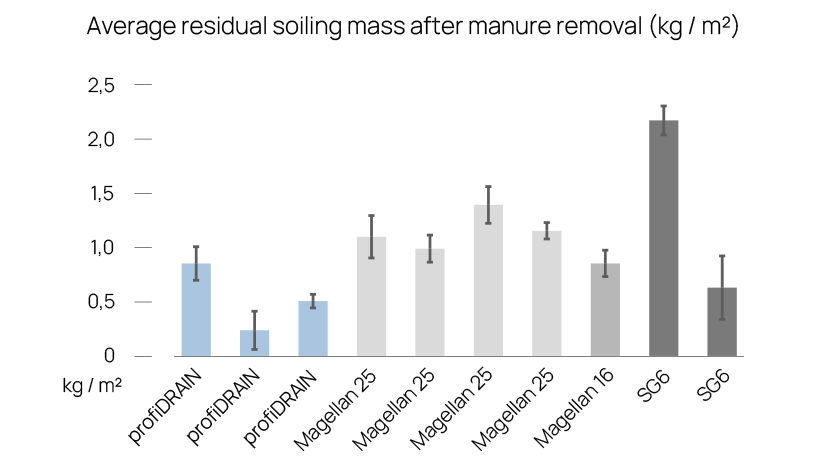
• For the profiDRAIN grooved floors included in the study, an  average residual soiling level of 0.5 kg/m² was measured after manure removal

Figure 6: Residual soiling mass in kg per m2 according to grooved-flooring type and farm (profiDRAIN: n=3, Magellan 25: n=4, Magellan 16: n=1, SG6: n=2)

Manure removal frequency as a critical factor for cleanliness

The authors of the study also emphasize that the frequency of manure removal plays a central role in the soiling of the walking areas and “that soiling can be significantly reduced by more frequent manure removal”. According to recommendations, manure removal should take place at least every two hours.

As the study further shows, the residual soiling mass is even lower (0.3 kg per m²) on sloped floors than on grooved floors.

Source: Schrade, S., Bossler, A., & Zähner, M. (2025). Solid floors with grooves and with a slope: investigations of exercise areas’ soiling and residual soiling mass on dairy farms. Agricultural engineering.Eu, 80(4).

View study

Note: The results shown apply only to the farms included in the study and the conditions under which the study was conducted. They do not support conclusions that apply to all farms, conditions of use, or flooring solutions available on the market. Presenting these results does not constitute an independent ranking or an assessment that any solution is superior.